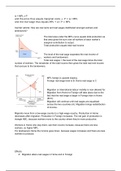
URI CHM 103 EXAM 1 LATEST UPDATE GRADED A+
URI CHM 103 EXAM 1 LATEST UPDATE GRADED A+ **What is density?** Density is calculated as mass divided by volume. **How do you calculate percent error?** Percent Error = ((Theory - Actual) / Theory) × 100% **What does percent accuracy measure?** Percent Accuracy = (Actual / Theory) × 100% **Which elements are halogens?** Halogens include F, Cl, Br, I, and At. **Define molecular weight.** Molecular Weight is the sum of atomic weights. **What is the formula for calculating atomic weight?** Atomic Weight Formula: AW = Σ(isotope % × isotope mass) / 100 **What is Avogadro's number?** Avogadro's number is 6.022 × 10^23. **How is the volume of 1 mole of a substance determined?** 1 mol vol = (1 mol) × (molecular weight in g/mol) / (density in g/mL) **How is the percent mass of an atom in a compound calculated?** Percent Mass of Atom in Compound = (Mass of Atom × 100%) / Mass of Compound **Describe electrons in terms of their properties.** Electrons: 1/1836 amu, -1 charge, located outside the nucleus. **Describe neutrons in terms of their properties.** Neutrons: In the nucleus, no charge, 1 amu, composed of 1 up quark and 2 down quarks, free neutrons decay. **What role does the weak force play in atomic particles?** Weak Force: It holds neutrons together. **Describe protons in terms of their properties.** Protons: In the nucleus, +1 charge, 1 amu, composed of 2 up quarks and 1 down quark. **What role does the strong force play in atomic particles?** Strong Force: It binds protons to neutrons. **How is the mass number of an atom determined?** Mass Number = Protons + Neutrons Atomic number # protons and # electrons U Uranium Th Thorium Sn Tin Sb Antimony Pb Lead Hg Mercury Au Gold Ag Silver Kr Krypton Ar Argon Ne Neon He Helium Br Bromine Cl Chlorine F Flourine Se Selenium S Sulfer O Oxygen As Arsenic P Phosphorus N Nitrogen Ge Germanium Si Silicon C Carbon Ga Gallium Al Aluminium H Hydrogen B Boron Zn Zinc Cu Copper Ni Nickel Co Cobalt Fe Iron Mn Manganese Cr Chromium V Vanadium Ti Titanium Sc Scandium Ca Calcium Mg Magnesium Be Beryllium K Potassium Na Sodium Li Lithium Heterogeneous mixtures Ex. Fruit salad, pizza, wood Homogeneous mixtures Ex. Salt water, gasoline Elements Ex. Carbon, oxygen Compound Ex. Water, sugar, salt Democritus Greek, 460-370 BC First person to suggest atoms were the basis of matter (logically) Established "the void" "The Void" Established by Democritus, stated that the void was spaces in between atoms making up matter, shot down by Aristotle Atoms Comes from "atomos" -> "no cut" John Dalton English, Father of modern atomic theory, based on experimental evidence with gases Model of Matter All matter is composed of atoms, unique atoms=elements, molecules=collections of bonded atoms, compounds= molecules atoms and ions, chemical reactions don't create or destroy atoms but can for compounds Chemical changes Not always reversible, accompanied by a change in composition, new types of matter being created Physical changes Reversible, don't change composition, nothing new created, doesn't change relationships b/w atoms Chemistry The study of the physical and compositional changes of matter, "central science" Matter Anything with mass, occupies space and is made of atoms Mass Measure of the amount of matter in an object, independent of location
Schule, Studium & Fach
- Hochschule
- URI CHM 103
- Kurs
- URI CHM 103
Dokument Information
- Hochgeladen auf
- 30. juni 2024
- Anzahl der Seiten
- 11
- geschrieben in
- 2023/2024
- Typ
- Prüfung
- Enthält
- Fragen & Antworten
Themen
-
uri chm 103 exam 1 latest update graded a

Ebenfalls erhältlich im paket-deal