Operations Management
7. Tutorial: Inventory Management (Part 2) – Blanks
Exercise 1: Newsvendor Model with Discrete Demand Distribution
A kiosk owner faces the question, how many copies of the New York Times he should order
daily. In the past, the order quantity was determined intuitively „by emotion“. Thereby, he has
observed that newspapers often remained unsold in the evening resp. that his order quantity
was not enough for the demand of one day.
The newspapers are sold to the consumer for € 2.50 per piece. The kiosk owner sources them
for € 2.00 per piece. He can return unsold newspapers of the day to the publisher and receives
50 Cent per newspaper.
Fortunately, the kiosk owner has recorded the demand for newspapers during the last 100
days. This resulted in the following demand distribution for the New York Times (rounded
frequencies):
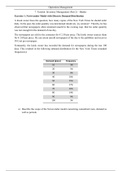
Demand [piece] Frequency
10 3%
20 5%
30 8%
40 10%
50 15%
60 17%
70 16%
80 14%
90 9%
100 3%
a) Describe the scope of the Newsvendor model concerning considered costs, demand as
well as periods.
, b) Assist the kiosk owner with optimizing the order quantity of the New York Times. At
first, draw the frequency distribution of the demand.
1,2
1
0,8
Frequency
0,6
0,4
0,2
0
Demand [piece]
2
7. Tutorial: Inventory Management (Part 2) – Blanks
Exercise 1: Newsvendor Model with Discrete Demand Distribution
A kiosk owner faces the question, how many copies of the New York Times he should order
daily. In the past, the order quantity was determined intuitively „by emotion“. Thereby, he has
observed that newspapers often remained unsold in the evening resp. that his order quantity
was not enough for the demand of one day.
The newspapers are sold to the consumer for € 2.50 per piece. The kiosk owner sources them
for € 2.00 per piece. He can return unsold newspapers of the day to the publisher and receives
50 Cent per newspaper.
Fortunately, the kiosk owner has recorded the demand for newspapers during the last 100
days. This resulted in the following demand distribution for the New York Times (rounded
frequencies):
Demand [piece] Frequency
10 3%
20 5%
30 8%
40 10%
50 15%
60 17%
70 16%
80 14%
90 9%
100 3%
a) Describe the scope of the Newsvendor model concerning considered costs, demand as
well as periods.
, b) Assist the kiosk owner with optimizing the order quantity of the New York Times. At
first, draw the frequency distribution of the demand.
1,2
1
0,8
Frequency
0,6
0,4
0,2
0
Demand [piece]
2